> For the complete documentation index, see [llms.txt](https://help.openloyalty.io/llms.txt). Markdown versions of documentation pages are available by appending `.md` to page URLs; this page is available as [Markdown](https://help.openloyalty.io/implementation-guide/members-and-activity/members/member-list/single-member-view/referrals.md).
# Referrals
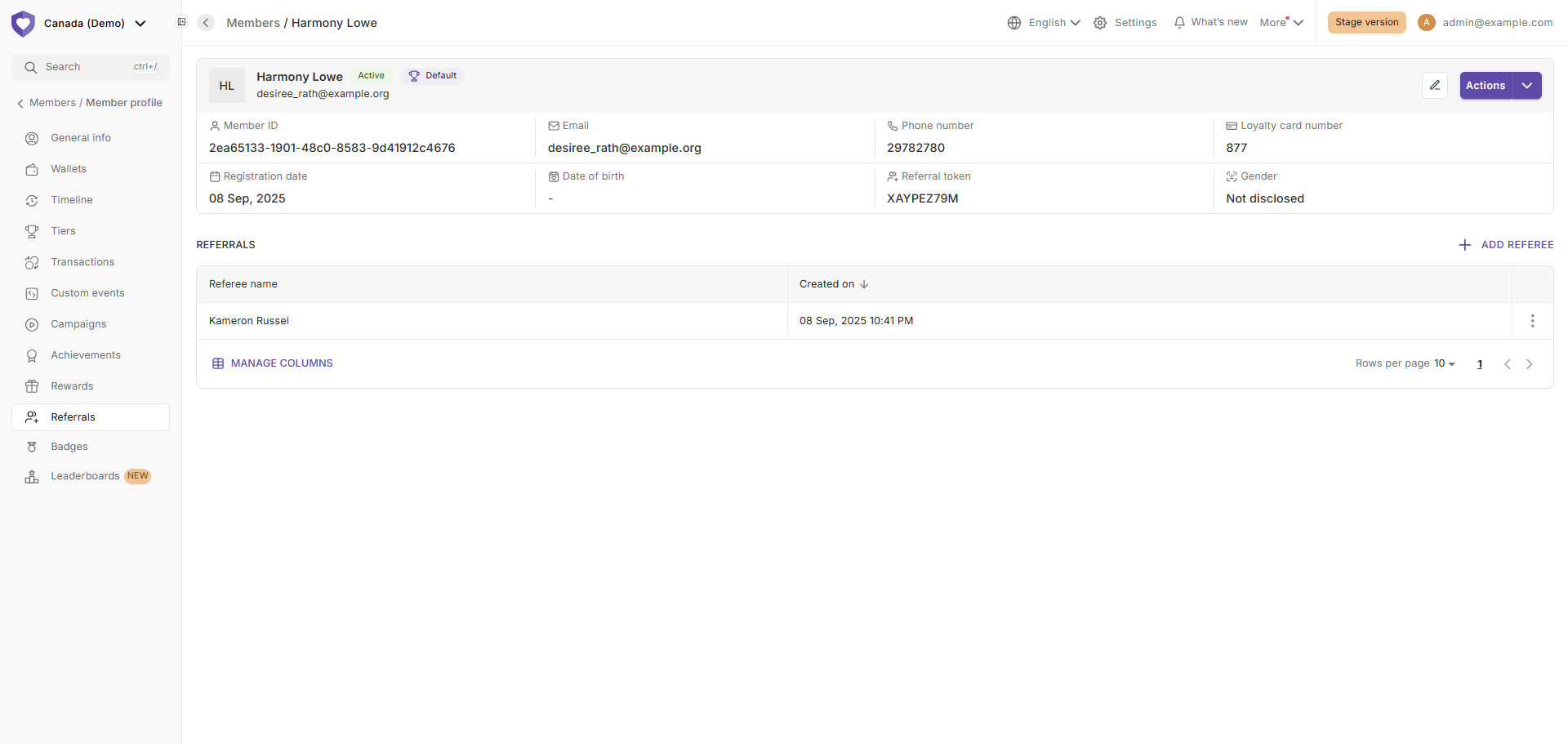
The **Referrals** tab allows you to view and manage referral relationships associated with a specific member. This section displays details of referees (people invited by the member into the program) and provides tools for adding, viewing, or removing referees.
***
### Referrals list
The main table displays all referees linked to the member. For each entry, you can see:
* **Referee name** – the name of the invited person.
* **Created on** – the date and time when the referral was recorded.
***
### Adding a referee
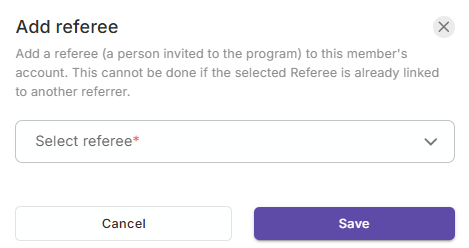
You can manually add a referee to the member’s account:
* Click **Add referee**.
* In the popup, select a referee from the dropdown list of existing members.
{% hint style="warning" %}
A referee cannot be linked if they are already assigned to another referrer.
{% endhint %}
* Click **Save** to confirm.
This action creates a referral relationship between the member (as referrer) and the selected referee.
***
### Managing referees
Each referee entry has a context menu with available actions:
* **Remove referee** – deletes the referral link between the member and the selected referee.
* **See full profile** – opens the full profile of the referee in a new view.
***
### Key notes
* Referrals are permanent unless manually removed.
* Referral rewards or campaign triggers tied to referrals are handled automatically by the system once the relationship is created.
* Manual management (adding or removing referees) should be used carefully to avoid inconsistencies in reporting or campaign logic.
***
To find out more about the referrals, please refer to these sections of the User Guide:
{% content-ref url="/pages/Lywj6gE33DaBkknwW3HW" %}
[Referral Programs](/implementation-guide/faq/referral-programs.md)
{% endcontent-ref %}
{% content-ref url="/pages/cZWRhDrCnzhts1bUxARY" %}
[Referred Members](/implementation-guide/members-and-activity/members/referred-members.md)
{% endcontent-ref %}
{% content-ref url="/pages/2TMM68lFVeTp1OgMW7Gf" %}
[Referral Campaign](/implementation-guide/campaigns/campaigns/campaigns-and-referral-campaigns/creating-campaigns/referral-campaign.md)
{% endcontent-ref %}
---
# Agent Instructions
This documentation is published with GitBook. GitBook is the documentation platform designed so that both humans and AI agents can read, navigate, and reason over technical content effectively. Learn more at gitbook.com.
## Querying This Documentation
If you need additional information that is not directly available in this page, you can query the documentation dynamically by asking a question.
Perform an HTTP GET request on the following URL with the `ask` and `goal` query parameters:
```
GET https://help.openloyalty.io/implementation-guide/members-and-activity/members/member-list/single-member-view/referrals.md?ask=&goal=
```
`ask` is the immediate question: it should be specific, self-contained, and written in natural language.
`goal` is what the user is ultimately trying to achieve, the reason they need the answer. Sharing it helps GitBook give you a better, more relevant answer. A goal is most helpful when it describes the outcome the user wants rather than restating the question. For example, with `ask=how do I create an API token`, a goal like `build a script that syncs our docs to a CMS` lets GitBook tailor the answer to that use case.
The response will contain a direct answer to the question and relevant excerpts and sources from the documentation.
Use this mechanism when the answer is not explicitly present in the current page, you need clarification or additional context, or you want to retrieve related documentation sections.