> For the complete documentation index, see [llms.txt](https://help.openloyalty.io/llms.txt). Markdown versions of documentation pages are available by appending `.md` to page URLs; this page is available as [Markdown](https://help.openloyalty.io/implementation-guide/members-and-activity/members/member-list/single-member-view/tiers.md).
# Tiers
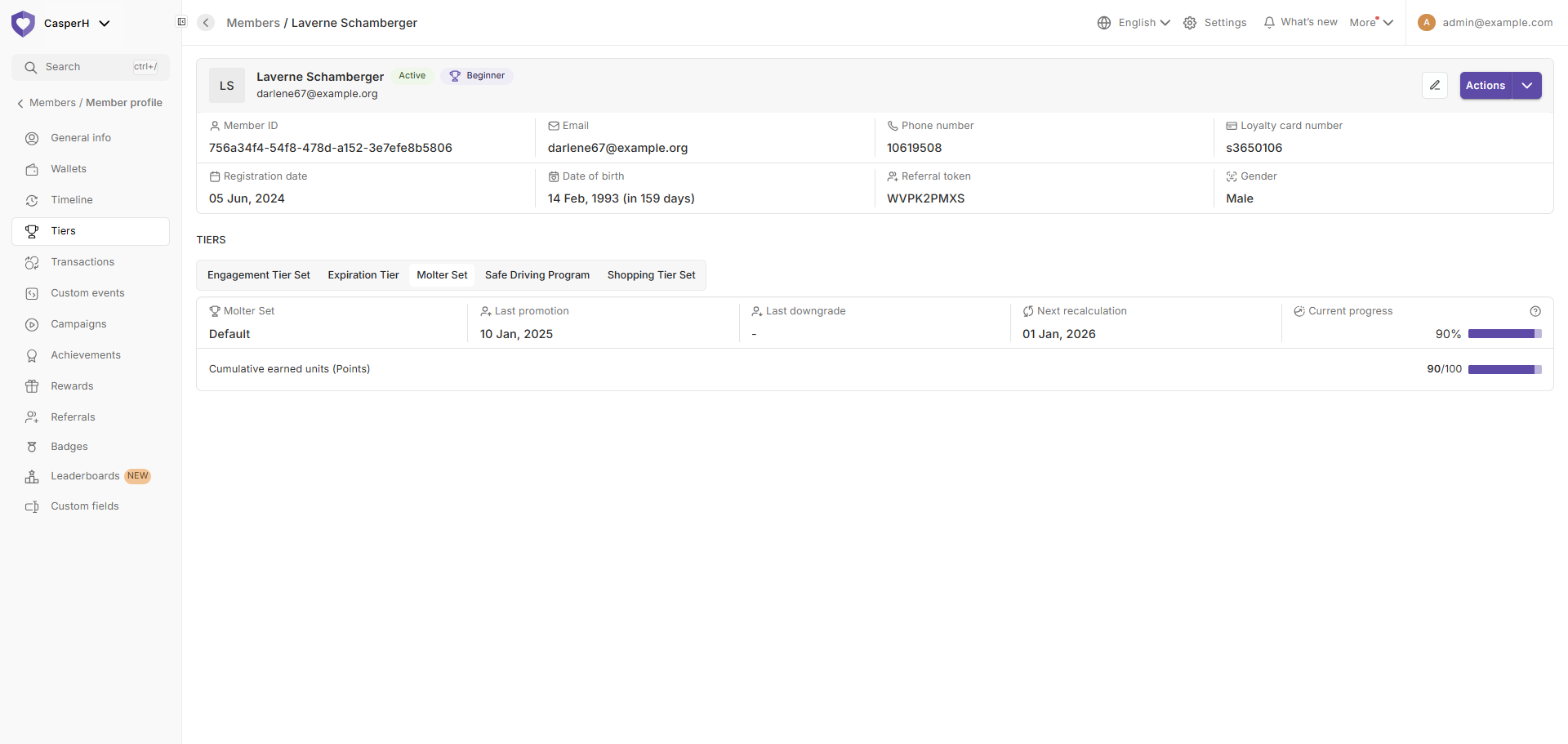
The **Tiers** tab in the single member profile provides detailed insight into a member’s current position in the loyalty program’s tier structure, their historical movements between tiers, and their progress toward the next recalculation.
***
### Key elements
* **Tier sets** – All available tier sets are displayed (e.g., Engagement Tier Set, Expiration Tier, Shopping Tier Set).
* **Current tier** – Shows the tier the member currently belongs to within a given tier set.
* **Last promotion / downgrade** – Indicates when the member was last promoted or downgraded.
* **Next recalculation** – Date of the next scheduled tier recalculation.
***
### Progress tracking
* **Cumulative earned units** – shows how many units the member has accumulated towards tier calculation.
{% hint style="info" %}
Depending on how the tier set is configured, this metric can display:
* **Active points**
* **Total earned points**
* **Total transactions**
* **Months since joining the program**
* or another metric defined in the tier configuration.
{% endhint %}
* **Progress bar** – visual representation of progress toward the next recalculation.
* **Current progress %** – percentage completed for the ongoing cycle.
***
To find out more about the tiers module, please refer to this section of the User Guide:
{% content-ref url="/pages/-MZBspk\_YeJoAJMpx6a5" %}
[Tiers](/implementation-guide/gamification/tiers.md)
{% endcontent-ref %}
---
# Agent Instructions
This documentation is published with GitBook. GitBook is the documentation platform designed so that both humans and AI agents can read, navigate, and reason over technical content effectively. Learn more at gitbook.com.
## Querying This Documentation
If you need additional information that is not directly available in this page, you can query the documentation dynamically by asking a question.
Perform an HTTP GET request on the following URL with the `ask` and `goal` query parameters:
```
GET https://help.openloyalty.io/implementation-guide/members-and-activity/members/member-list/single-member-view/tiers.md?ask=&goal=
```
`ask` is the immediate question: it should be specific, self-contained, and written in natural language.
`goal` is what the user is ultimately trying to achieve, the reason they need the answer. Sharing it helps GitBook give you a better, more relevant answer. A goal is most helpful when it describes the outcome the user wants rather than restating the question. For example, with `ask=how do I create an API token`, a goal like `build a script that syncs our docs to a CMS` lets GitBook tailor the answer to that use case.
The response will contain a direct answer to the question and relevant excerpts and sources from the documentation.
Use this mechanism when the answer is not explicitly present in the current page, you need clarification or additional context, or you want to retrieve related documentation sections.