> For the complete documentation index, see [llms.txt](https://help.openloyalty.io/llms.txt). Markdown versions of documentation pages are available by appending `.md` to page URLs; this page is available as [Markdown](https://help.openloyalty.io/implementation-guide/rewards-redemption/rewards.md).
# Rewards
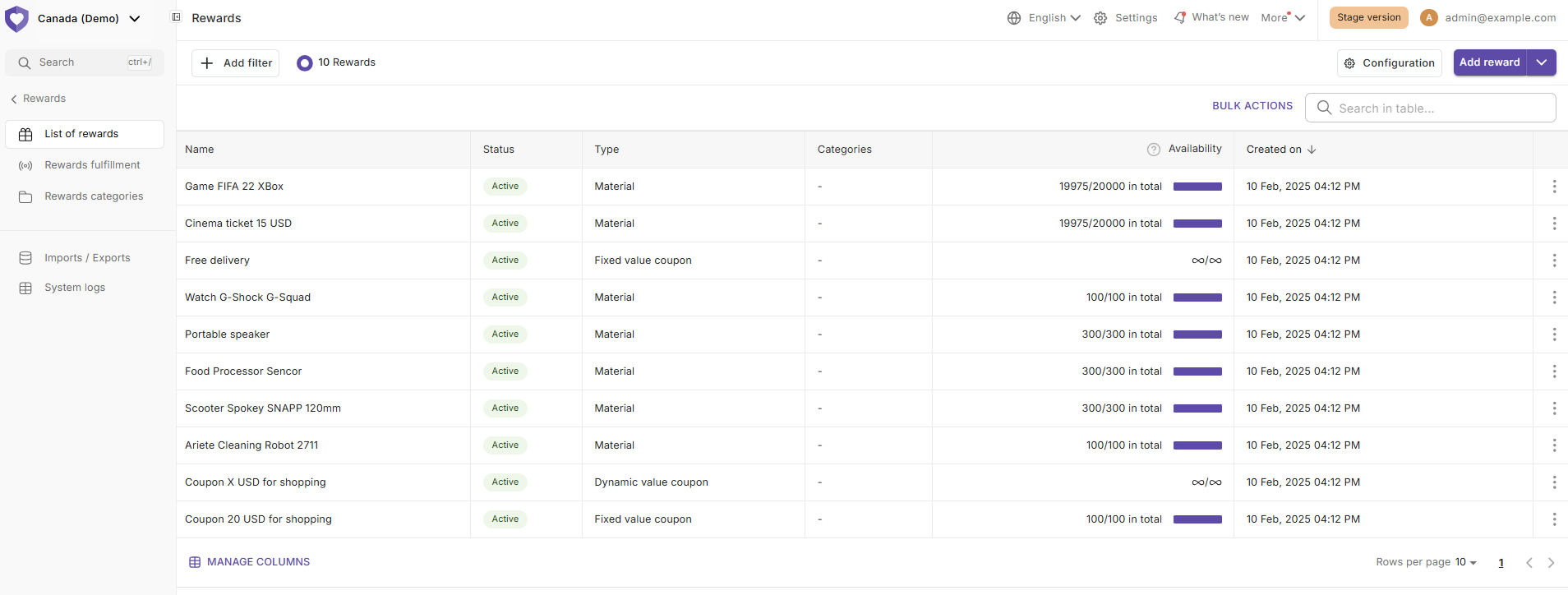
In this section, you will get to know everything related to Rewards. You’ll be familiar with creating and managing Rewards available within your Loyalty Program.
## Overview
Rewards are the benefits that members can redeem in exchange for their loyalty points or other program currencies. They are one of the most important parts of your loyalty program - they motivate customers, strengthen engagement, and drive repeated behaviour.
In Open Loyalty, rewards can be:
* 📦 **Material rewards** – physical gifts like gadgets, accessories, or event tickets.
* 🎟️ **Coupons** – digital codes that unlock discounts, credits, or free products.
You can create rewards, assign them to campaigns, and track their entire lifecycle - from setup through redemption to fulfillment.
***
## What you’ll learn in this section
In this section, you will learn how to:
* 👀 Explore and filter the **List of Rewards**.
* 🛠️ **Create new rewards** step by step.
* 🎟️ Configure **coupon types and sources**.
* 🗂️ Organize rewards into **categories**.
* 📊 Track redemptions in **Reward Fulfillment**.
* ⚙️ Set up the **wallets** for redemptions.
* ✏️ Manage existing rewards (edit, duplicate, cancel, expire).
## Learn more about
---
# Agent Instructions
This documentation is published with GitBook. GitBook is the documentation platform designed so that both humans and AI agents can read, navigate, and reason over technical content effectively. Learn more at gitbook.com.
## Querying This Documentation
If you need additional information that is not directly available in this page, you can query the documentation dynamically by asking a question.
Perform an HTTP GET request on the following URL with the `ask` and `goal` query parameters:
```
GET https://help.openloyalty.io/implementation-guide/rewards-redemption/rewards.md?ask=&goal=
```
`ask` is the immediate question: it should be specific, self-contained, and written in natural language.
`goal` is what the user is ultimately trying to achieve, the reason they need the answer. Sharing it helps GitBook give you a better, more relevant answer. A goal is most helpful when it describes the outcome the user wants rather than restating the question. For example, with `ask=how do I create an API token`, a goal like `build a script that syncs our docs to a CMS` lets GitBook tailor the answer to that use case.
The response will contain a direct answer to the question and relevant excerpts and sources from the documentation.
Use this mechanism when the answer is not explicitly present in the current page, you need clarification or additional context, or you want to retrieve related documentation sections.