> For the complete documentation index, see [llms.txt](https://help.openloyalty.io/llms.txt). Markdown versions of documentation pages are available by appending `.md` to page URLs; this page is available as [Markdown](https://help.openloyalty.io/playbook/sample-setups/sample-campaigns/1-earn-1-point-for-every-usd1-spent.md).
# #1 Earn 1 point for every $1 spent
## **#1 Earn 1 point for every $1 spent**
**Business goals:**
* Number of transactions
* Transaction value
**Loyalty mechanism:** Currency
**Description:**
* A classic spend-based loyalty campaign that rewards members for every purchase they make.
* The earning rule takes into consideration the value of the transaction. The bigger the value of the transaction, the higher the number of the loyalty currency is.
* The campaign is perfect for building permanent shopping habits among newly registered members of the loyalty program.
* Especially effective in industries with commodity goods with a wide range of products.
**Default configuration:**
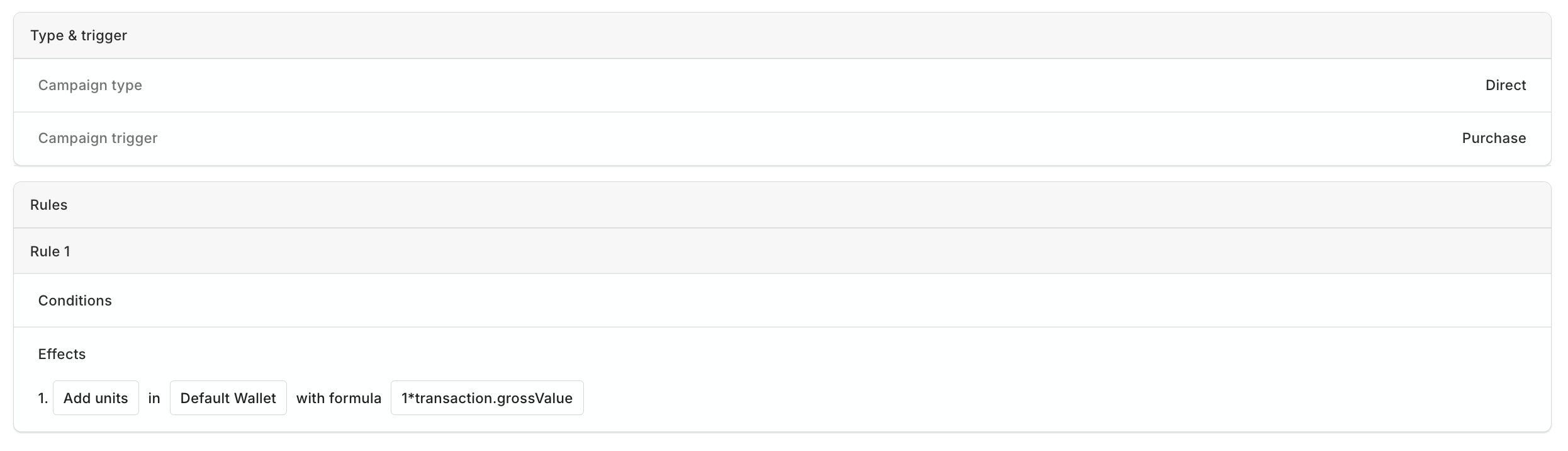
Campaign details preview
* **Campaign type:** Direct
* **Trigger:** Purchase
* **Rules:**
* **Conditions:** None
* **Effects:** Give 1 point for every $1 spent\
*(Add units -> Wallet type: Points wallet -> Calculation formula: 1 \** transaction.grossValue*)*
{% hint style="info" %}
**Actionable tips:**
* Set up a daily or hourly limit to avoid fraud.
* Set up a budget for the total number of loyalty currency to control the costs of the campaign.
* Exclude low-margin product categories from the calculation to increase the campaign ROI.
* Define different calculation ratios for different tiers to maximize the customer's lifetime value.
{% endhint %}
### Campaign JSON file to import
{% file src="/files/6oaXeJvqPQ5D6aWBy2CJ" %}
---
# Agent Instructions
This documentation is published with GitBook. GitBook is the documentation platform designed so that both humans and AI agents can read, navigate, and reason over technical content effectively. Learn more at gitbook.com.
## Querying This Documentation
If you need additional information that is not directly available in this page, you can query the documentation dynamically by asking a question.
Perform an HTTP GET request on the following URL with the `ask` and `goal` query parameters:
```
GET https://help.openloyalty.io/playbook/sample-setups/sample-campaigns/1-earn-1-point-for-every-usd1-spent.md?ask=&goal=
```
`ask` is the immediate question: it should be specific, self-contained, and written in natural language.
`goal` is what the user is ultimately trying to achieve, the reason they need the answer. Sharing it helps GitBook give you a better, more relevant answer. A goal is most helpful when it describes the outcome the user wants rather than restating the question. For example, with `ask=how do I create an API token`, a goal like `build a script that syncs our docs to a CMS` lets GitBook tailor the answer to that use case.
The response will contain a direct answer to the question and relevant excerpts and sources from the documentation.
Use this mechanism when the answer is not explicitly present in the current page, you need clarification or additional context, or you want to retrieve related documentation sections.